
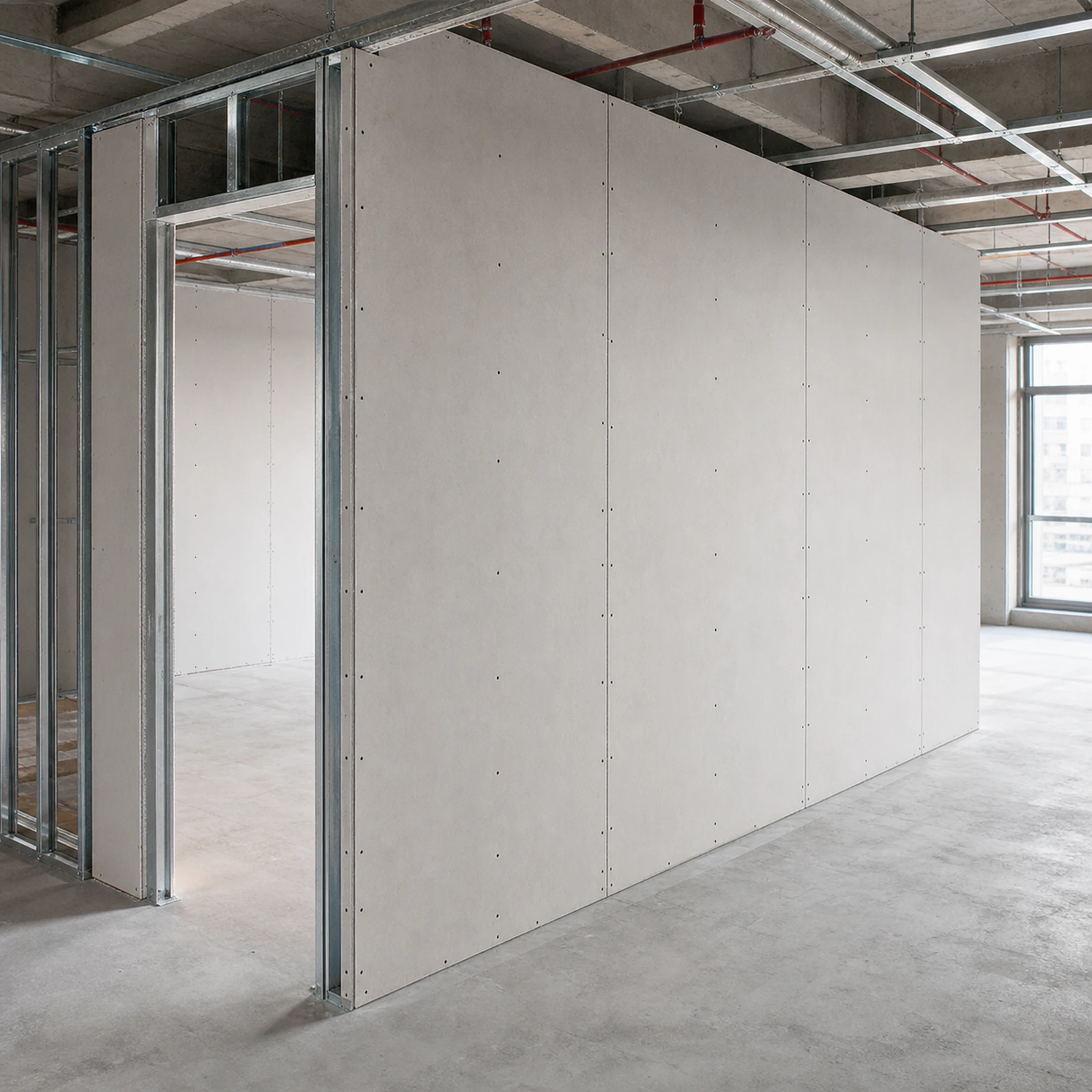
Specifying a fire rated partition board for a humid climate requires more than comparing board thickness and an hourly rating. Hotels, hospitals, schools, modular buildings, warehouses and commercial interiors in coastal or tropical regions may expose wall materials to high relative humidity during transport, storage and service. The safest procurement approach is to evaluate the board, framing, fixings, joints, insulation and penetrations as one documented wall system.
This guide gives overseas buyers, architects and contractors nine practical checks for comparing partition systems without treating a single board certificate as proof for every possible wall build-up.
Why Humidity Changes Fire Rated Partition Board Selection
Humidity does not automatically make a compliant partition unsafe, but it can affect handling, dimensional movement, joint finishing, metal components and site storage. A board that performs well in a dry laboratory can still be installed incorrectly after wet transport, prolonged outdoor storage or uncoordinated finishing work.
For that reason, buyers should start with the intended application and accepted wall design. Mainland’s interior partition panels page outlines the main system variables to discuss before quotation, while the interior and partition solutions category helps project teams compare related board options.
9 Critical Fire Rated Partition Board Checks
1. Match the Fire Test to the Target Market
Ask which test standard, classification method and local approval route apply to the destination country. Common examples include ASTM E119 and UL 263 in North American specifications, and EN 1364-1 for fire-resistance testing of non-loadbearing walls in relevant European projects. Do not assume that a report written to one standard will be accepted by every authority.
2. Verify the Complete Tested Assembly
An hourly fire-resistance result belongs to the tested or assessed assembly. Confirm the board manufacturer and type, thickness, number of layers, framing profile, stud spacing, cavity insulation, screw pattern, joint treatment, perimeter seal and test orientation. Replacing one component can move the proposed wall outside the evidence scope.
3. Separate Reaction to Fire from Fire Resistance
Reaction-to-fire classification describes how a material contributes to fire under specified test conditions. Fire resistance describes how an element such as a wall maintains integrity, insulation and, where relevant, loadbearing capacity for a period under a defined test. Procurement documents should state which result is required instead of using terms such as “fireproof” without a test method and scope.
4. Request Moisture-Related Test Data and Conditioning Details
Ask the supplier to identify the test method used for water absorption, moisture movement, dimensional stability or wet-condition strength. Compare results only when the methods and specimen conditioning are equivalent. A percentage without a named method, specimen thickness and conditioning procedure is difficult to use in a technical submittal.
5. Coordinate Studs, Fixings and Corrosion Protection
High humidity and coastal exposure can increase the importance of metal coating and fastener selection. The project team should specify stud depth and gauge, track details, screw type, screw length, edge distance and fixing centres according to the accepted wall design. Corrosion protection should suit the project’s environmental exposure and local code requirements.
6. Treat Joints and Perimeters as System Components
Joint compound, tape, sealant, backing material and perimeter gaps are not cosmetic details in a rated wall. Confirm whether control joints are required, how the head-of-wall connection accommodates movement and which firestop products are permitted. Site teams should not substitute generic sealants without documented compatibility.
7. Plan Every Service Penetration
Cables, pipes, ducts, electrical boxes and access panels can interrupt a fire-resisting barrier. Ask the designer or fire consultant to select tested penetration and joint systems that match the wall construction and services. The board supplier can provide product data, but project-specific firestop design remains a system coordination responsibility.
8. Define Transport, Storage and Installation Controls
Export boards should be protected from rain, standing water, edge impact and excessive bending during loading and unloading. Request pallet dimensions, board count, gross weight, container loading method and moisture protection. On site, store boards flat, supported and covered according to the manufacturer’s instructions, then allow suitable acclimatisation before finishing where required.
9. Build a Traceable Supplier Submittal
A useful submittal connects the quotation to a clearly identified product and wall configuration. Request the current technical data sheet, test report or classification reference, installation guide, product label, batch traceability method, packing specification and written list of proposed deviations. Our existing guide, 7 Proven Checks for a Fire-Rated Partition Board Submittal, provides a focused document review checklist.
Technical Parameters for a Fire Rated Partition Board RFQ
A professional request for quotation should describe the required system rather than asking only for a price per sheet. Use the following schedule as a starting point and replace each item with project-specific values.
| Parameter | What the buyer should specify | Evidence to request |
|---|---|---|
| Wall duty | Non-loadbearing partition, shaft wall, corridor, wet-area backing or technical room | Application statement and system drawing |
| Fire performance | Required duration, test standard, exposure direction and local approval route | Test or classification report with assembly details |
| Board configuration | Board type, nominal thickness, layers per side, edge profile and finish | Technical data sheet and product identification |
| Framing | Stud and track profile, gauge, spacing, wall height and deflection requirement | Tested design or engineering assessment |
| Fixing and joints | Screw type and spacing, joint tape, compound, perimeter gap and sealant | Installation guide and approved component list |
| Humidity exposure | Project climate, wet-area use, transport season and storage conditions | Relevant test methods, conditioning details and handling guide |
| Logistics | Sheet size, quantity, destination port, pallet limits and delivery phases | Packing plan, container quantity and lead time |
How to Compare Fire Rated Partition Board Quotations
Two quotations are comparable only when they cover the same board configuration, tolerances, documentation, packing and delivery terms. A lower sheet price may exclude tested accessories, protective packing, inspection or required export documents. Create a compliance matrix with one row for every mandatory requirement and mark each response as confirmed, conditional or not offered.
- Confirm whether quoted thickness and dimensions are nominal or measured tolerances.
- Record which accessories and installation consumables are included.
- Identify report numbers and verify that the proposed board appears within their scope.
- Compare pallet weight and container payload, not only sheets per pallet.
- Request samples from the same proposed product grade before final approval.
- Agree how production batches and labels will be traced across phased deliveries.
For broader risk control, review how to avoid fire compliance risks with A1-rated cement boards. It explains why product classification and assembly fire resistance must remain separate in specifications and sales documents.
Fire Rated Partition Board FAQ
Does a thicker fire rated partition board always provide a longer rating?
No. Thickness can be one variable, but the rating depends on the complete tested or assessed wall assembly, including layers, frame, fixings, insulation, joints and penetrations. Approve the specific build-up supported by the applicable evidence.
Can one test report be used for every board size and wall height?
Not automatically. Test and classification documents define the specimen, field of application and permitted variations. Changes in wall height, framing, board orientation or component brands may require an extended application, engineering assessment or new approval.
What should an importer check before placing a container order?
Confirm the approved product code, dimensions and tolerances, quantity, packing, pallet weight, loading plan, production lead time, inspection method, document package and destination requirements. Keep the approved sample and signed specification linked to the purchase order.
Which information should be sent to the manufacturer for a project quotation?
Send the destination country, building type, wall application, required standard and rating, board dimensions, estimated quantity, delivery schedule, destination port and available wall drawings. This allows the supplier to identify gaps before pricing.
Prepare a Clear Fire Rated Partition Board Enquiry
A reliable fire-rated partition begins with a clear performance brief and traceable evidence. Share your wall build-up, destination standard, humidity exposure, quantities and delivery programme through our project enquiry page. The Mainland team can then discuss suitable board options, documentation, samples and export packing for your procurement review.