

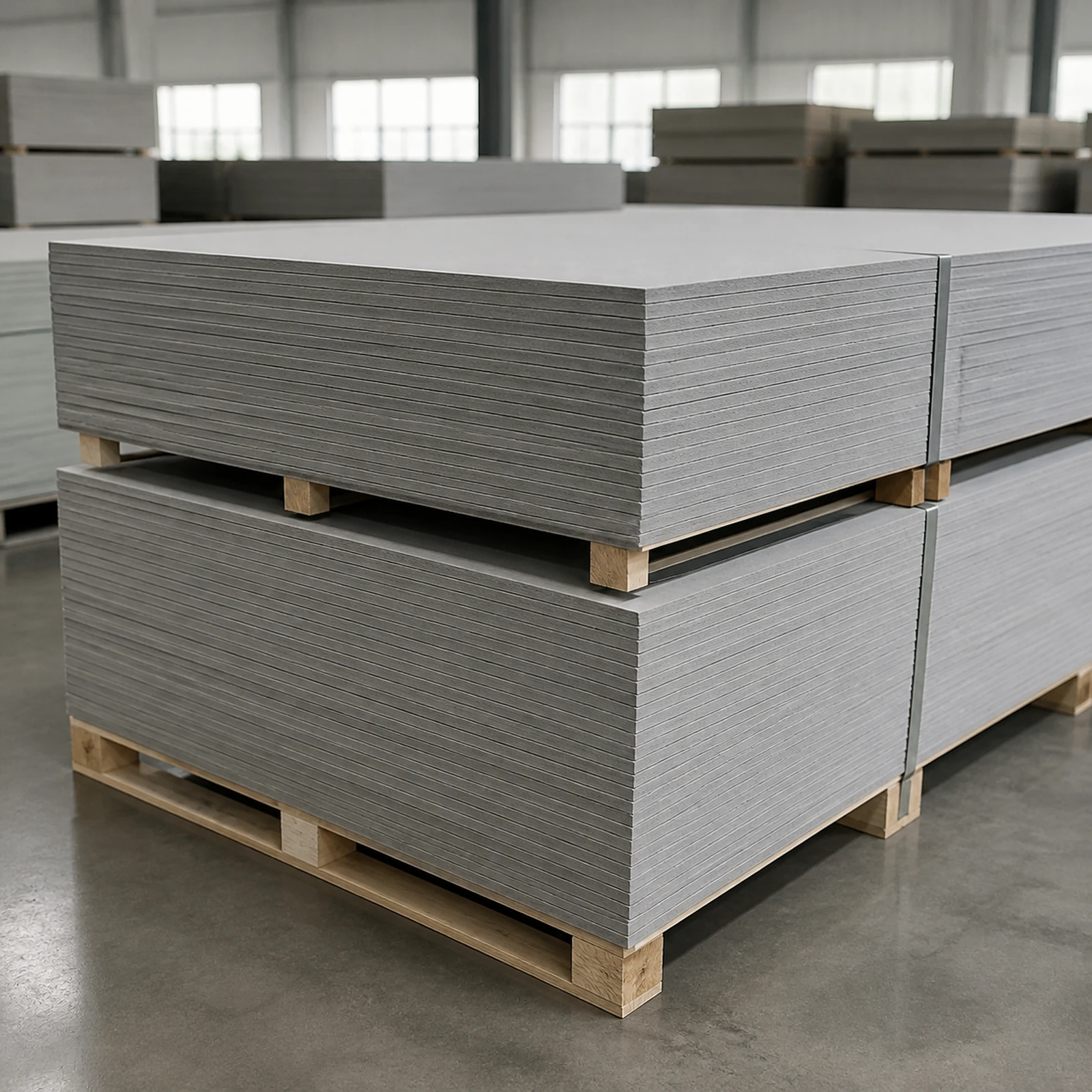
Selecting a calcium silicate board supplier is only the first step in an export project. Boards that meet the approved specification can still arrive with chipped corners, stained faces, mixed labels or unstable pallets when the packing plan is treated as a generic shipping detail.
For overseas distributors, contractors and project procurement teams, packing should be controlled as part of the product specification. This guide explains eight practical checks covering board schedules, sheet-mass estimates, pallet support, edge protection, traceability and container loading evidence. Buyers can first review Mainland’s standard calcium silicate board product page and the wider interior and partition solutions category before preparing an RFQ.
Why Export Packing Needs a Written Specification
Calcium silicate boards are flat mineral-based panels, but an export shipment is not a single board. It is a system of boards, separators, pallet supports, straps, labels and container restraints. A weak element can transfer load to board edges or allow sheets to move during handling.
A professional quotation should therefore separate three subjects: the board specification, the pallet specification and the container-loading plan. Approval of one does not automatically approve the other two. Buyers should also distinguish cosmetic acceptance criteria from dimensional or performance requirements.
Eight Export Packing Checks for B2B Buyers
1. Freeze the Board Schedule Before Designing Pallets
Ask the supplier to issue a board schedule showing product grade, length, width, thickness, edge detail, finish, sheet quantity and intended application. Pallet design depends on these inputs. Mixed thicknesses or sizes should not be combined without a clear separation and labeling method.
For wet-area or high-humidity interior projects, compare the packing plan with the selection points in our calcium silicate board supplier guide for wet areas. The approved board and the shipped board must remain traceable to the same specification.
2. Estimate Sheet and Pallet Mass
Buyers can make an initial mass estimate from the declared dimensions and density:
Estimated sheet mass (kg) = length (m) x width (m) x thickness (m) x declared density (kg/m3)
This calculation is useful for comparing packing proposals, but the final pallet and container plan should use the supplier’s confirmed shipment mass. Manufacturing tolerances, surface treatment and actual product condition can affect the result. The RFQ should state the maximum acceptable pallet mass, local unloading equipment and any warehouse rack limits.
3. Require Full, Flat Pallet Support
The board stack should be supported evenly rather than resting on a few narrow points. Ask for a pallet drawing or photographs showing the deck, bearers and fork-entry direction. The pallet footprint should suit the board size and planned handling method.
Uneven support can concentrate load during lifting or storage. A calcium silicate board supplier should explain how the stack remains flat from factory packing through container unloading, not simply state that wooden pallets are included.
4. Protect Faces, Corners and Edges Separately
Face protection and edge protection solve different problems. Interleaving sheets or a clean top cover can reduce surface marking, while rigid corner and edge protectors help distribute strapping pressure. Buyers should specify whether exposed faces, square edges or decorative surfaces require additional protection.
Straps should secure the load without becoming direct cutting points on the board edges. The approved packing sample should show the actual strap position, protector type and stack height.
5. Define Moisture Protection Without Trapping Wet Product
Outer wrapping should be selected for the shipping route, storage period and destination climate. However, wrapping is not a substitute for controlling the condition of the boards before packing. Ask the supplier to describe its pre-packing inspection, wrapping material, top and bottom protection, and storage instructions after arrival.
Avoid unsupported promises such as “waterproof packing.” Instead, define observable requirements: intact outer protection, clean boards, dry loading conditions, protected pallet bases and documented handling instructions.
6. Make Every Pallet Traceable
Each pallet label should identify the purchase order, product, dimensions, thickness, quantity, pallet number and production or inspection reference used by the supplier. Where a container includes several specifications, use a packing list that maps every pallet number to its exact contents.
This reduces receiving time and makes a shortage or quality claim easier to investigate. Our existing article on supplier batch and document control provides additional checks for matching samples, production lots and reports.
7. Review the Container Stowage Plan
The container plan should consider payload, internal space, pallet orientation, weight distribution, door clearance and unloading sequence. Container capacity should not be estimated from sheet count alone. The logistics provider and shipper must confirm the applicable payload and transport requirements for the actual booking.
Ask how the supplier prevents longitudinal and lateral movement, how voids are managed, and whether heavy pallets can be unloaded safely at the destination. Photographs should show the container floor before loading, pallet positions, restraints and the condition at door closure.
8. Set a Pre-Shipment Evidence Package
Agree on evidence before production starts. A practical package can include approved board and packing specifications, dimensional inspection results, pallet labels, pallet photographs, packing list, loading photographs and final shipment quantities.
The evidence should support release decisions, not replace independent inspection where the contract requires it. For large or repeat orders, define the inspection sampling plan, claim-notification period and responsibility for replacement or credit in the purchase agreement.
Technical Packing Schedule for an RFQ
| RFQ field | What the buyer should specify | Supplier evidence |
|---|---|---|
| Board identification | Grade, application, size, thickness, edge and finish | Approved data sheet and board schedule |
| Quantity control | Sheets per pallet, pallets per specification and total sheets | Numbered packing list |
| Pallet limits | Maximum gross mass, dimensions and fork-entry direction | Pallet drawing or approved packing sample |
| Surface protection | Interleaving, top cover, bottom protection and cleanliness | Close-up packing photographs |
| Edge protection | Corner protectors, edge protectors and strap positions | Photographs before and after strapping |
| Identification | PO, product, dimensions, quantity, pallet and batch references | Label artwork and pallet photographs |
| Container loading | Pallet sequence, restraints, weight distribution and unloading plan | Loading plan and container photographs |
| Acceptance | Sampling, visible defects, quantity tolerance and claim process | Pre-shipment inspection record |
How to Compare Supplier Packing Quotations
A low packing charge does not necessarily mean a lower delivered cost. Compare quotations on the same board schedule and request the gross pallet mass, sheets per pallet, pallets per container, protective materials and loading method. Then review the destination costs for unloading, storage, waste and replacement risk.
For mixed orders, ask suppliers to show the calculation for each board specification. Do not accept one average sheet weight for multiple sizes and thicknesses. The quantity summary should reconcile with the commercial invoice and packing list before shipment release.
Pre-Shipment Acceptance Checklist
- Approved product code and dimensions match the purchase order.
- Sheet and pallet quantities reconcile with the packing list.
- Pallet support, stack height and fork-entry direction match the approved plan.
- Faces, corners and edges are protected as specified.
- Labels are readable and unique to each pallet.
- Mixed specifications are separated and easy to identify.
- Loading photographs show restraint and door clearance.
- Inspection records and shipment documents are complete.
FAQ
How should buyers calculate the approximate weight of a calcium silicate board?
Multiply board length, width and thickness in metres by the declared density in kg/m3. Use the result only as a planning estimate and obtain the supplier’s confirmed sheet and pallet masses for the final loading plan.
Can different board thicknesses share one pallet?
They can only be considered when the supplier provides a stable separation, protection and labeling plan accepted by the buyer. Separate pallets are usually easier to count, unload and trace.
What information should appear on a pallet label?
At minimum, include the purchase order, product identification, dimensions, thickness, sheet quantity, pallet number and the supplier’s batch or inspection reference.
Does plastic wrapping make calcium silicate board export packing waterproof?
No packing description should be treated as an absolute guarantee. Buyers should define the wrapping system, board condition before packing, pallet-base protection, loading conditions and storage instructions as separate requirements.
What photographs should be requested before shipment?
Request photographs of the empty pallet, board stack, face and edge protection, labels, completed pallets, container floor, loading sequence, restraints and closed container doors. The purchase contract should state when photographs are required for release.
Prepare a Comparable Supplier RFQ
A dependable calcium silicate board supplier should be able to convert a board schedule into a measurable packing and loading proposal. Send Mainland the application, board dimensions, thicknesses, quantities, destination port, unloading limits and documentation requirements through the project inquiry page. The team can then discuss samples, packing details and a comparable export quotation.