
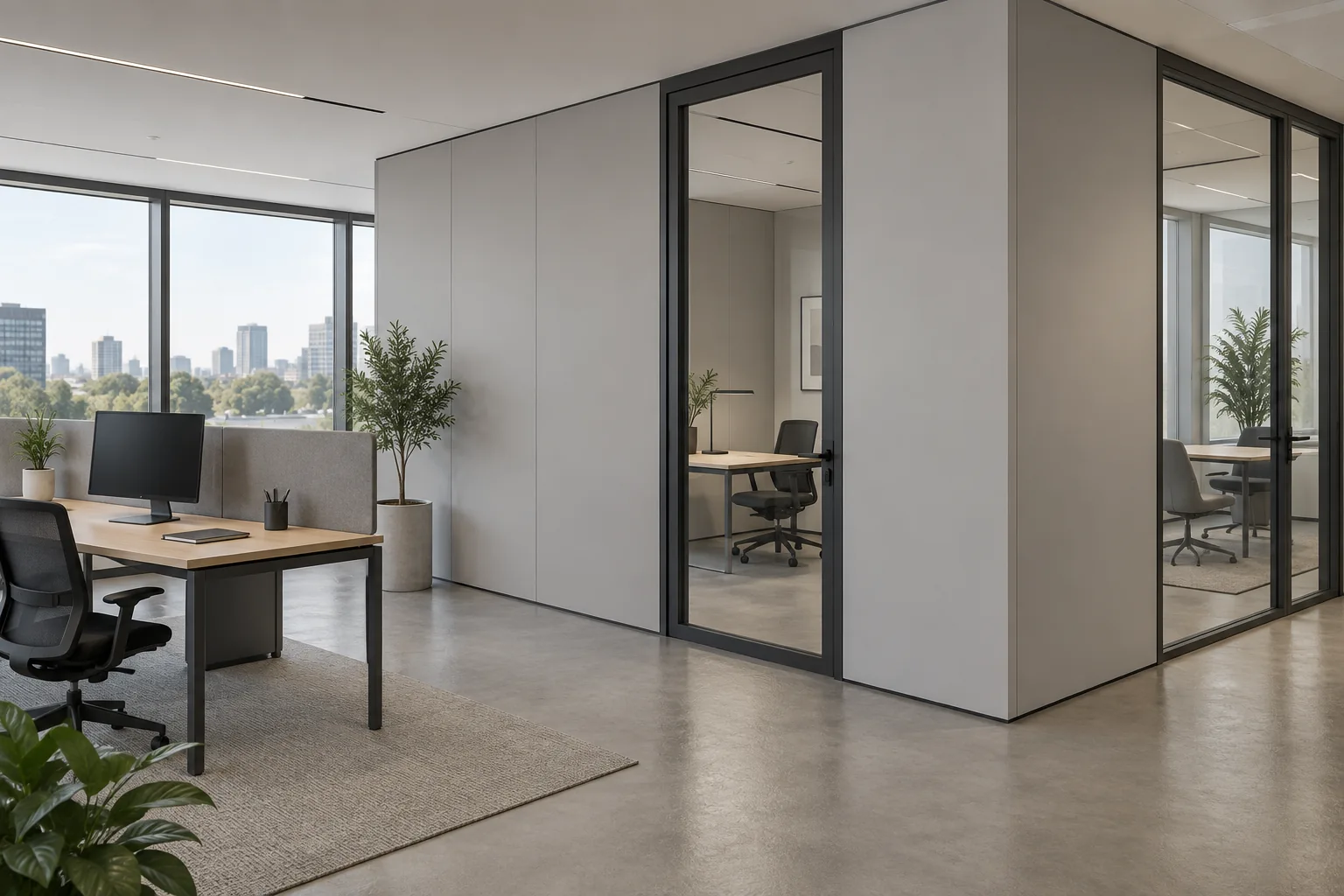
A fire rated partition board enquiry often includes a second requirement: sound separation between hotel rooms, offices, classrooms or apartments. Buying a thicker sheet is not a complete acoustic specification. The board, framing, cavity, connections and surrounding construction must be considered together.
This guide gives overseas B2B buyers, architects and contractors seven checks for coordinating fire and acoustic evidence before ordering. It does not prescribe a tested Mainland wall or promise a particular rating. The featured image is an illustrative application concept, not evidence of a certified assembly.
1. Define the Acoustic Metric, Not Just a Number
Write the required metric, test method and acceptance stage into the wall schedule. A quotation stating only “soundproof” or “50 dB” leaves important questions unanswered.
STC and Rw need their own evidence
Sound Transmission Class (STC) is a single-number classification associated with ASTM E413; laboratory transmission-loss measurements may be made under ASTM E90. The ASTM E413 scope identifies the relevant ratings and measurement routes. STC is a rating, so specify “STC 50,” not an unspecified “50 dB insulation.”
Rw, expressed in dB, is a different weighted airborne sound-insulation quantity used in the ISO framework. ISO 717-1 describes rating quantities and their derivation from measured frequency-band results. Do not treat an STC value as automatically equivalent to an Rw value.
Ask the acoustic consultant to identify the appropriate field metric as well as any laboratory requirement. Keep airborne sound separation distinct from sound absorption: an absorption claim for a finish is not a partition transmission rating.
2. Compare Complete Wall Build-Ups
Request a drawing and report that identify the tested wall rather than a standalone board sample. Connect that identification to the product code on the quotation and the intended manufacturing source.
- Board designation, nominal thickness in mm and number of layers on each face.
- Stud section, material, spacing in mm, and the stated wall-height limits.
- Cavity depth in mm and insulation type, thickness and density where specified.
- Fastener type, fixing pattern, joint arrangement and perimeter treatment.
- Any resilient channels, separated frames or other connection details.
These are information fields, not universal installation values. Review our Interior & Partition Panels as a starting point for product selection, then ask what documentation is available for the exact proposed build-up. A product listing is not approval of its acoustic or fire performance.
3. Check Fire and Acoustic Evidence Against the Same Design
Keep the fire-resistance and acoustic reports together, but do not assume one proves the other. Confirm that both describe a construction compatible with the proposed wall schedule, including the cavity contents and connection details.
UL’s guidance on critical components explains that a fire-resistance-rated design is a complete assembly built from specified components. This principle is not a claim that Mainland products have UL certification. A board’s reaction-to-fire classification also does not establish the fire-resistance duration of an arbitrary wall.
An illustrative enquiry, not a performance claim
Suppose a design brief requests a 120-minute fire-resisting partition and laboratory STC 50. Record these as two separate project targets, with their required test or classification methods. Obtain evidence for the proposed construction and the responsible reviewers’ acceptance. Neither figure is a Mainland product rating or a universal building-code requirement.
If acoustic changes introduce a different board, insulation or connection, use our partition board substitution approval guide to record the change before production or installation.
4. Identify Flanking Paths Before Trusting a Laboratory Rating
Sound may reach the adjoining room through junctions and surrounding construction rather than only through the separating wall. NRC Canada’s soundPATHS explanation distinguishes direct transmission from flanking transmission and notes the importance of walls, floors and their junctions.
For the project review, mark floor, soffit, facade and adjoining-wall interfaces on the drawings. Ask whether a common ceiling void, connecting structure or service route needs a coordinated detail. A laboratory wall result should not be advertised as a guaranteed room-to-room result after construction.
Assign responsibility for these interfaces before tender comparison. Otherwise, a buyer may select a panel package while leaving the surrounding details unspecified.
5. Coordinate Doors, Services and Seals
Prepare an opening schedule covering doors, access panels, socket boxes, ducts and pipe or cable penetrations. Ask the relevant designers and system suppliers how each item is addressed in both the acoustic design and the fire strategy.
Do not substitute a general acoustic sealant for a required firestop, or assume that a firestop automatically supplies the acoustic performance needed at that location. Confirm substrate, joint movement, opening dimensions and the evidence scope for each specified system.
Keep perimeter and service details attached to the wall reference. This makes competing quotations easier to compare without using unsupported universal screw spacing, insulation density or sealant-depth figures.
6. Compare Installed Cost, Not Board Thickness Alone
Different proposals may use different layer counts, framing arrangements or accessories. Request the complete bill of materials and installed wall thickness, rather than ranking quotations by board price alone.
Check whether the proposed assembly meets room-layout constraints, service space and the agreed wall height. Ask the supplier to separate confirmed product information from values still awaiting project review. For alternative panel families, browse the Interior & Partition Solutions category, but compare alternatives against the same design brief.
7. Agree Inspection and Acceptance Before Shipment
Put board identity, dimensions, tolerances, packing and batch identification into the purchase specification. Separately record the wall-design revision, evidence references, accepted variations and site inspection responsibilities.
Keep a pre-closure hold point
Use our partition installation inspection checklist to plan checks before concealed work is covered. Photograph representative framing, cavity contents and interfaces, and close out discrepancies against the approved documents.
If field acoustic testing is required, agree its method, locations, timing and acceptance criteria with the acoustic consultant before handover. A visual inspection and a board delivery certificate do not replace a specified performance test.
Fire Rated Partition Board Acoustic FAQ
Does a thicker board automatically give a higher STC?
No universal STC increase can be assigned from thickness alone. Compare evidence for the complete construction, including the frame, connections, cavity and board layers.
Can I use an STC report to satisfy an Rw requirement?
Not by assuming the numbers are interchangeable. Ask the reviewer whether the available measurement data and rating method support the metric required by the project.
Does an acoustic test report prove fire resistance?
No. Acoustic and fire requirements need their own evidence, and the proposed construction must remain within the accepted scope of each.
What should an overseas buyer send with an enquiry?
Send the wall schedule, required fire and acoustic metrics, board dimensions, quantities, project location and destination port. Identify interfaces, openings and any requested field acceptance tests.
Prepare a Coordinated Partition Enquiry
Contact Mainland with the proposed wall build-up and procurement requirements to discuss available boards, samples and supporting documents. Resolve evidence gaps with the responsible project reviewers before committing to bulk supply.