
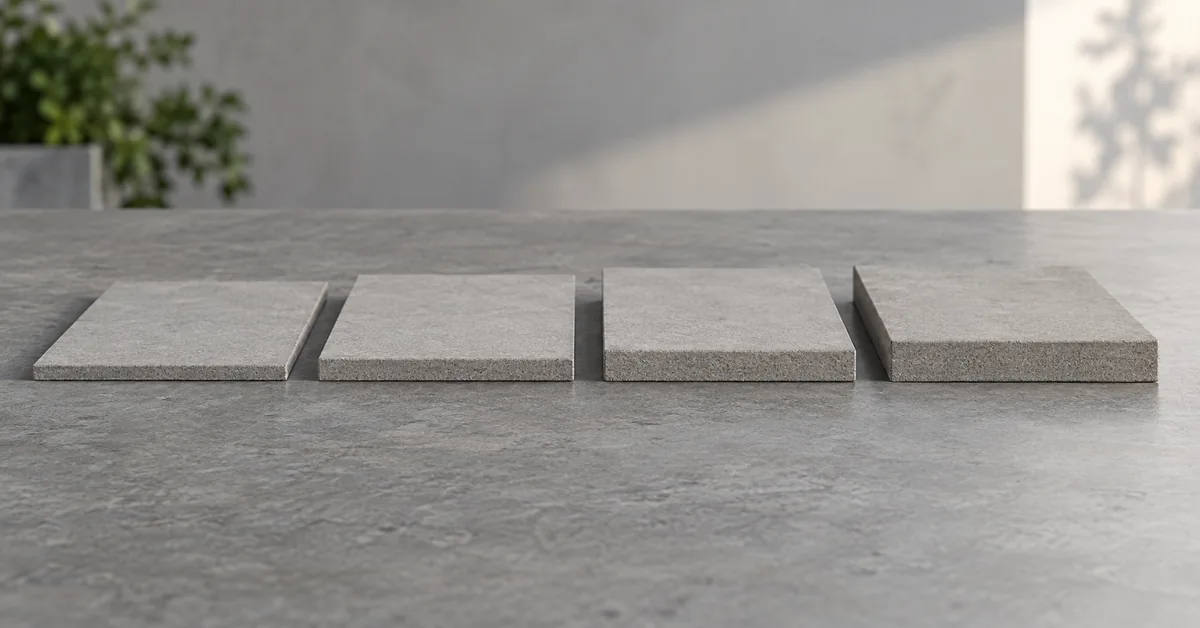
Dimensional consistency is one of the first issues an overseas buyer should examine when qualifying a fiber cement board manufacturer. A board may have the correct nominal thickness and sheet size on paper, yet uncontrolled variation can still affect framing alignment, joint width, fastener positioning, finishing work, pallet stability and installation speed.
This guide gives distributors, architects, contractors and procurement teams a practical method for reviewing tolerances before approving samples or placing a repeat order. The exact acceptance limits must come from the declared product specification, applicable project requirements and an agreed inspection plan; they should never be assumed from a generic product name.
Why Board Tolerances Matter in B2B Procurement
Fiber cement boards are supplied for different applications and performance levels. A thin interior lining board, a facade panel and a flooring substrate may use different formulations, densities, edge profiles and production controls. Buyers should therefore compare like with like and connect every tolerance to a defined product code.
Consistent dimensions can reduce site trimming and help installers maintain regular joints. They also support more predictable packing and container loading. However, dimensional checks do not replace fire, moisture, mechanical or system-level verification. Review the relevant technical documents together with project drawings and local requirements.
A Practical Incoming-Inspection Matrix
| Property | Recommended check | Procurement action |
|---|---|---|
| Thickness | Measure at agreed positions away from damaged edges | Record nominal value, tolerance and instrument |
| Length and width | Use a calibrated tape or suitable measuring device | Compare each result with the approved datasheet |
| Squareness | Compare diagonals or use an agreed square method | Define the maximum permitted difference |
| Flatness | Place the board on the agreed reference surface | State how bow and warp will be measured |
| Edge condition | Inspect chips, cracks, taper or machined profiles | Separate cosmetic and functional defects |
| Identification | Check product code, batch and pallet labels | Link results to the production lot |
This is a planning framework, not a universal acceptance standard. Sampling frequency, conditioning, instruments and limits should be agreed before production.
8 Checks for Manufacturer Tolerance Control
1. Lock the Exact Product Grade Before Comparing Samples
Begin with a single product identity: application, nominal density range, thickness, dimensions, surface, edge type and intended exposure. Do not combine measurements from different grades in one approval record. The standard fiber cement board product page can be used to start the discussion, but the final purchase order should identify the precise supplied grade.
2. Define Where Thickness Will Be Measured
A useful inspection plan states the number of readings per board and the distance from corners and edges. It should also identify the measuring instrument and its resolution. Measuring only one convenient point can hide local variation, while measuring on a damaged edge can produce a misleading result. Record individual readings rather than only an average.
3. Check Length, Width and Diagonal Difference
Nominal sheet size affects framing layout, pallet design and container utilization. Length and width should be checked on a supported board without forcing it into shape. Comparing the two diagonals is a practical way to identify loss of squareness. For pre-cut OEM boards, confirm whether the same tolerance applies to every custom dimension.
4. Agree on a Repeatable Flatness Method
Words such as “flat” or “no warping” are not measurable acceptance criteria. The parties should agree on the reference surface, board orientation, support condition and method for recording the maximum gap. Moisture condition and storage history should also be noted because boards inspected immediately after uneven storage may not represent normal installed condition.
5. Inspect Edges Separately from Face Appearance
Square edges, tapered edges and machined profiles have different functional requirements. Check edge straightness, chips, corner damage and consistency of any factory machining. Surface color variation or small visual marks should be classified separately from defects that interfere with joints, fasteners or finishes. This distinction prevents unnecessary disputes while protecting installation quality.
6. Relate Density Checks to Moisture Condition
Density is calculated from mass and measured volume, so the moisture condition and dimensions used in the calculation matter. A buyer should not compare density figures from different conditioning methods as though they were identical. Ask the supplier to state the test basis and use density as one part of product verification, not as a standalone prediction of strength, fire performance or durability.
7. Use Lot-Based Sampling and Retain Records
The inspection plan should define what constitutes a production lot and how samples are selected across boards and pallets. Sampling only the top board of one pallet is rarely representative. For repeat orders, trend the results by batch instead of reviewing each shipment in isolation. This makes gradual process drift easier to identify and supports corrective action with evidence.
8. Connect Inspection Results to Pallet and Container Labels
Dimensional records are most useful when they can be traced to the shipped goods. Product code, batch number, thickness, dimensions, quantity and pallet number should be readable and consistent across the packing list and labels. Protective corners, moisture protection and pallet support should be reviewed as well, because transport damage can be mistaken for a production-tolerance problem.
How to Write the Requirement into a Purchase Order
A clear order specification should include the following items:
- Product code and intended application
- Nominal thickness, length and width
- Agreed tolerance for each measured property
- Edge profile, surface and finishing requirement
- Sampling frequency and acceptance method
- Required inspection record and batch identification
- Pallet protection, label content and destination port
Example wording: Dimensions and tolerances shall comply with the approved product datasheet and signed sample. Inspection method, sampling frequency and acceptance limits shall be agreed before mass production. Shipment records shall identify the corresponding production lot and pallet numbers.
Match Tolerance Control to the Final Application
Interior partitions, service areas and ceiling linings do not all impose the same dimensional or finishing priorities. Buyers comparing these applications can review the interior and partition solutions category. For a broader supplier assessment, see our existing guide on verifying fiber cement board manufacturer capacity and the article explaining quality control for export projects.
The strongest approval process combines a precise product specification, representative samples, documented inspection and a trial order where appropriate. This gives both buyer and manufacturer a shared definition of acceptable production rather than relying on subjective descriptions.
Frequently Asked Questions
What is the standard thickness tolerance for fiber cement boards?
There is no single tolerance that should be assumed for every fiber cement board. The acceptable value depends on the product grade, nominal thickness, declared standard, manufacturing specification and project requirement. Use the approved datasheet and purchase order as the controlling documents.
How many boards should a buyer measure?
The quantity should be set by the agreed lot size, risk level and sampling plan. Samples should be distributed across production lots and pallets rather than taken only from one accessible location.
Can density prove that two boards have the same performance?
No. Density can support product identification and consistency checks, but it does not by itself prove equal strength, moisture behavior, fire classification or system performance. Those properties require the appropriate product or assembly evidence.
Should the golden sample replace the technical datasheet?
No. A signed sample is useful for appearance and workmanship comparison, while the datasheet and purchase order define measurable requirements. All three should identify the same product grade.
What information is needed for an accurate quotation?
Provide the application, required thickness and dimensions, surface and edge profile, quantity, packing preference, documentation requirement and destination port. Use the project inquiry form to request product matching and an export quotation.