
Choosing a calcium silicate board supplier is a technical and commercial decision. A low quotation can become expensive if the board grade, moisture condition, tolerances, packing method or fire evidence does not match the project specification. This guide gives overseas distributors, architects and contractors a practical nine-point review before approving a first container.
1. Confirm the board grade and intended application
Start with the use case: interior partitions, ceiling systems, wet-area lining, shaft enclosures or another tested assembly. Calcium silicate boards are not interchangeable simply because they have similar names. Ask the supplier to identify the product grade, nominal density, thickness range, edge profile and recommended fixing method. Review the standard calcium silicate board range alongside the project drawings, rather than selecting by thickness alone.
2. Match thickness, density and board dimensions
For procurement, record thickness, length, width and density as separate acceptance criteria. Typical project schedules may call for thin ceiling boards, medium-thickness linings or heavier partition boards, but the correct value depends on the tested system. A useful purchase table should show the target value, permitted tolerance, test method and inspection frequency. Also confirm whether standard formats such as 1200 × 2400 mm or 1220 × 2440 mm are available, and whether custom sizes change the minimum order or lead time.
Why density should not be used as a shortcut
Density affects handling, weight and some performance characteristics, but it does not by itself prove a fire rating or suitability for a wall. Compare density with flexural strength, moisture behavior, dimensional stability and the complete tested assembly. The datasheet and test report should refer to the same product identity and thickness.
3. Check fire evidence at assembly level
Ask for the complete fire test or classification document, not only a marketing statement such as “two-hour fire resistant.” Verify the standard, laboratory, report number, specimen construction, board thickness, joints, framing, insulation, fasteners and permitted field of application. A board reaction-to-fire classification is different from the fire resistance period of a complete partition or ceiling assembly. The project consultant or authority having jurisdiction should confirm whether the evidence is acceptable in the destination market.
4. Review moisture, mould and dimensional-stability data
For humid climates, ask how the board is stored, conditioned and packed, and request the relevant moisture-absorption, water-resistance or dimensional-change data. Clarify whether the product is intended for dry interior use, intermittent humidity or a protected wet-area application. Confirm the required primer, joint treatment and surface coating. Moisture resistance of the board does not remove the need for correct detailing, ventilation and protection from prolonged water exposure.
5. Inspect samples using a written checklist
Approve samples against a signed reference sheet. Check color and surface texture, edge straightness, squareness, flatness, corner condition, visible voids and cut quality. Measure several points on more than one board, then keep a labelled retained sample. Our guide to approving calcium silicate board supplier samples provides a useful inspection sequence for distributors and project buyers.
6. Confirm cutting, fixing and finishing requirements
Before ordering, agree on the tools and installation method. Confirm screw type, edge distances, support spacing, joint treatment, tile or paint compatibility and whether boards need acclimatization before installation. If the panel will be cut on site, ask for guidance on dust control and edge sealing. A supplier who can provide a clear installation note reduces rework for contractors and helps distributors answer technical questions accurately.
7. Audit batch control and pre-shipment inspection
Request a sample batch number, production date, inspection record and certificate of conformity for each shipment. Ask how the factory controls raw-material dosing, curing, finishing, thickness and packing. For a first container, agree on an inspection plan that covers dimensions, appearance, quantity, packaging condition and document completeness. Photos alone are not a substitute for measurable acceptance criteria.
8. Compare packaging and container utilization
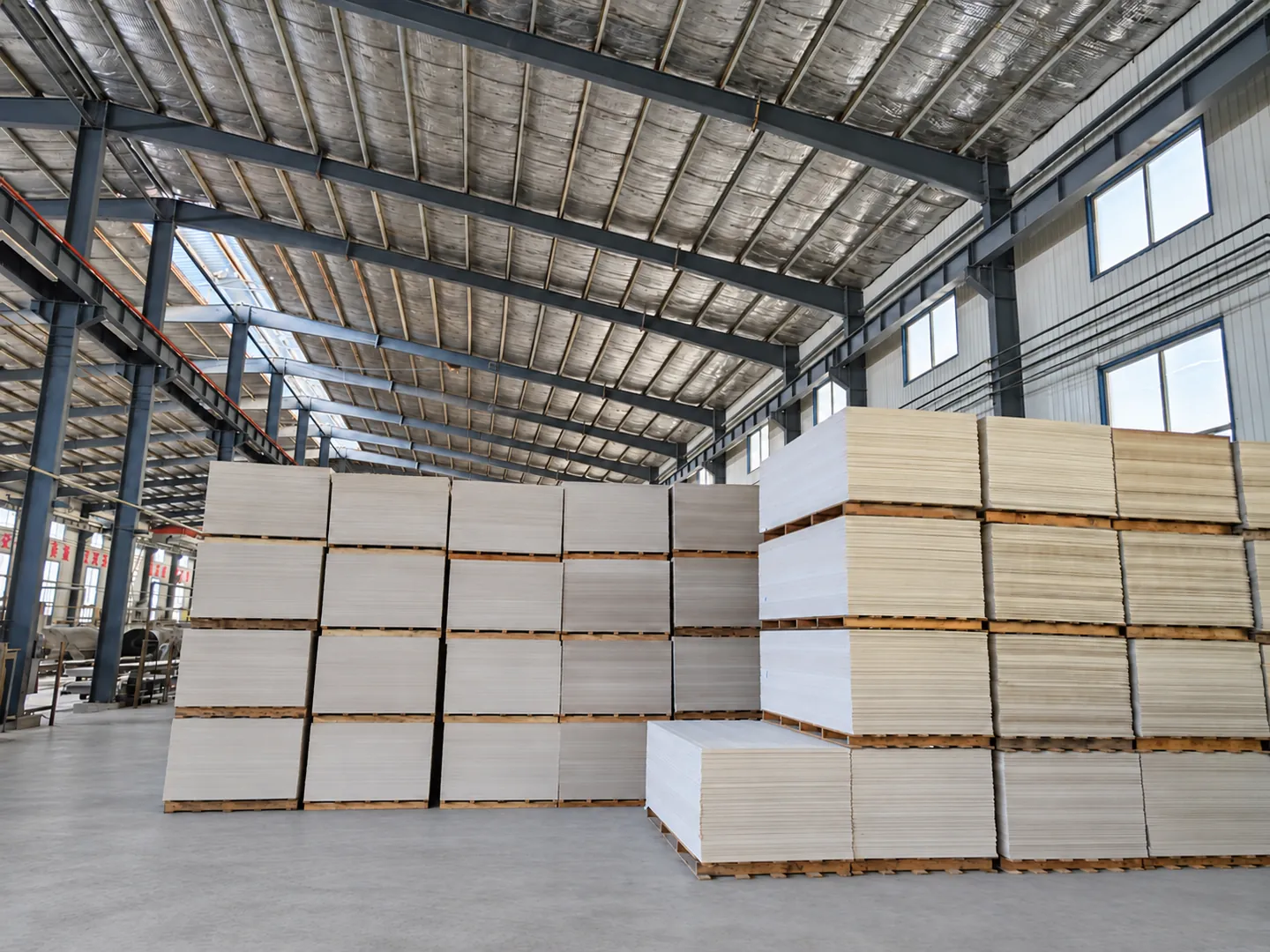
Board damage often occurs during handling and transit rather than production. Confirm pallet construction, corner protection, moisture barrier, strapping, carton or label information, maximum pallet weight and loading orientation. Request a container-loading plan showing pallet count, board quantity by thickness and spare space. If you need mixed specifications, obtain written confirmation of the loading sequence and identification marks before production.
9. Evaluate commercial reliability, not just price
Compare quotation validity, payment terms, production lead time, inspection hold points, replacement policy and export documents. A manufacturer-direct supplier should be able to explain who controls production, quality, packaging and shipping coordination. Ask how specification changes are approved and how non-conforming boards are handled. For category planning, see the interior and partition solutions category to compare related board applications before finalizing the purchase list.
A practical supplier comparison table
For each candidate, record: product code; application; thickness and tolerance; nominal density; standard size; strength data; moisture and dimensional-change data; fire document scope; test laboratory and report number; sample approval date; monthly capacity; lead time; pallet and container quantity; Incoterm; and warranty or claims procedure. This format makes quotations comparable and exposes missing evidence before money is committed.
FAQ for overseas buyers
Is a higher-density calcium silicate board always better?
No. Higher density may increase weight and handling demands. Select the board against the tested application, required strength, fire evidence, moisture conditions and installation method.
Can one fire report cover every thickness?
Not automatically. Check the report scope and field of application. A change in thickness, framing, insulation, fasteners or joint design may require separate evidence or technical approval.
What should be included in a first sample order?
Include the exact product code, thicknesses, dimensions, surface finish, labels and packing method intended for the production order. Keep retained samples and approve the written specification before container loading.
Final recommendation
The right calcium silicate board supplier should make the technical scope easy to verify. Start with application and assembly evidence, then confirm measurable board properties, sample quality, batch control and export packing. If you are comparing specifications for a project, send the required thickness, dimensions, quantity, destination and application so the supplier can return a product-specific quotation and document list.