
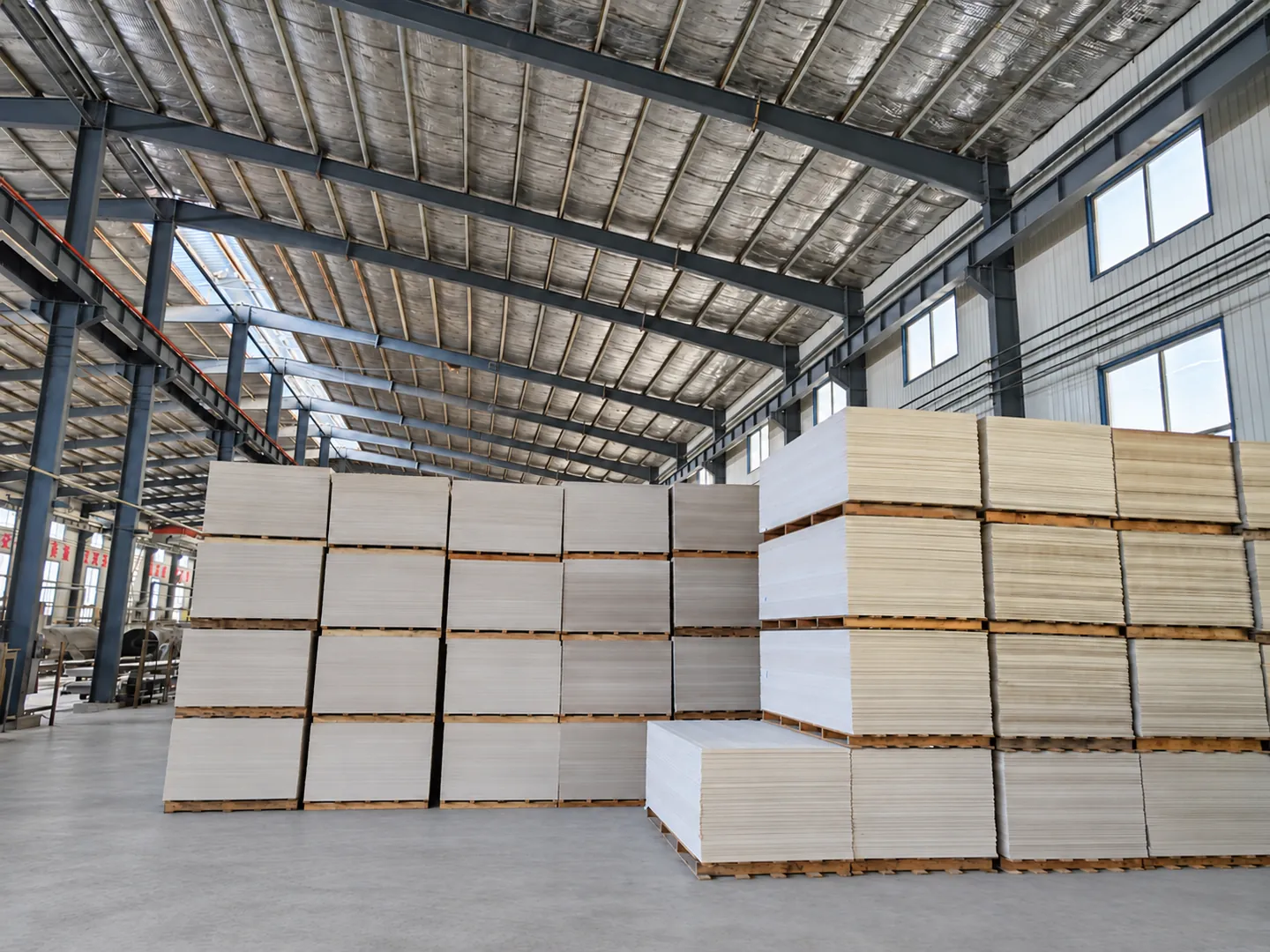
When comparing a calcium silicate board supplier, thickness and price are only part of the purchasing decision. Density, single-sheet mass and packed-pallet mass affect handling, storage, freight planning and the way competing quotations should be compared.
A density figure does not, by itself, establish fire resistance, acoustic performance or suitability for a particular wall. This guide explains seven practical checks for overseas distributors, contractors and procurement teams, with a worked calculation and the information to request before booking freight.
1. Identify the Board Grade and Density Basis
Start with the exact product designation. Ask whether the density is nominal, a typical average or an acceptance range, and whether it refers to a dry, conditioned or as-delivered specimen. Keep that description beside the value rather than transferring a number from another product in the same material family.
Match the number to its document
Record the datasheet revision, measurement method, specimen condition and any declared tolerance. Promat’s MASTERBOARD product information, for example, qualifies typical physical values by test procedure and intended use. It illustrates how a declaration should be read; its performance values do not describe Mainland boards.
Begin with our Standard Calcium Silicate Boards, then request the available data for the proposed grade, thickness and finish. A catalogue description is a starting point for discussion, not a substitute for an agreed purchase specification.
2. Use Consistent Units Before Comparing Offers
Density describes mass per volume. It is often stated in kg/m³ or g/cm³. A value of 1 g/cm³ equals 1,000 kg/m³. Sheet mass is stated in kg per sheet, while mass per area is stated in kg/m². These quantities answer different questions and should have separate quotation fields.
Convert thickness to metres
For a uniform, uncoated rectangular sheet, an estimate is:
Sheet mass (kg) = length (m) × width (m) × thickness (m) × density (kg/m³)
Mass per area (kg/m²) = thickness (m) × density (kg/m³)
Divide a thickness stated in millimetres by 1,000 before using these equations. Coatings, laminates and other added components need their own mass allowance. Where delivery-condition density differs from the stated test condition, obtain a measured delivery mass rather than treating the calculation as a guarantee.
3. Check a Single-Sheet Calculation
The following example is hypothetical and is not a Mainland product declaration, recommended thickness or loading commitment.
| Input or result | Illustrative value |
|---|---|
| Dimensions | 1.20 m × 2.40 m |
| Thickness | 9 mm = 0.009 m |
| Assumed density | 1,100 kg/m³ |
| Sheet area | 2.88 m² |
| Calculated mass per area | 9.9 kg/m² |
| Calculated sheet mass | 28.512 kg, approximately 28.5 kg |
Use the selected product’s actual inputs when comparing proposals. Ask for measured sheet or pallet mass and investigate a meaningful difference against dimensions, conditioning, finish and the agreed tolerance. Do not reject a shipment using an approximate calculation without an agreed inspection method.
4. Separate Board Mass from Packed-Pallet Mass
The net board mass is not the gross mass of the pallet. Ask the supplier to identify sheets per pallet and the mass of the pallet, wrapping, edge protection and other packaging. Confirm whether stated pallet dimensions include protective boards and any protruding parts.
In the hypothetical example, 50 sheets have a calculated net mass of 1,425.6 kg. Their packed pallet will have additional packaging mass. This is an arithmetic illustration, not a suggested stack height, pallet capacity or handling arrangement.
Request the measured packed mass, footprint, stack arrangement and lifting requirements for the actual order. Coordinate these with the receiving warehouse and handling provider. Our calcium silicate board shipping-damage guide covers protection and transport interfaces in more detail.
5. Build the Container Plan from the Actual Order
A fixed statement such as “800 sheets per container” cannot describe every thickness, grade, pallet arrangement and transport route. A mixed order needs a schedule showing each product, sheet count, net mass, packed dimensions and gross pallet mass.
Payload and verified gross mass are different checks
Confirm the assigned container’s permitted limits and the limits applicable to the inland route with the transport provider. Separately arrange the verified gross mass required for the ocean shipment. The IMO guidance on verified gross mass identifies the shipper’s responsibility and the permitted verification methods. A board-count estimate does not replace that process.
The IMO/ILO/UNECE CTU Code provides guidance on packing and securing across the transport chain. Discuss load distribution, securing and unpacking with the responsible provider; a numerical mass limit alone does not establish a suitable loading arrangement.
6. Compare Weight Alongside the Application Requirements
A lighter sheet may affect handling and transport, but density does not establish every mechanical or fire property. Compare the proposed grades against the same intended use, thickness, finish, installation details and evidence requirements.
For ceiling linings, the designer needs the specified board mass and supporting-system information. For partitions, the board forms part of a complete wall construction. Browse the Interior & Partition Solutions category to compare board families, then review product-specific documents rather than assuming interchangeable performance.
7. Put Mass and Acceptance Fields into the RFQ
Ask your calcium silicate board supplier to return a consistent schedule for each proposed grade:
- Product designation, dimensions, thickness and finish.
- Density value, unit, condition, method and declared tolerance.
- Mass per sheet and whether it is calculated or measured.
- Sheets per pallet, net board mass, gross pallet mass and packed dimensions.
- Mixed-order loading plan, route constraints and responsibility for freight verification.
- Inspection method, acceptance criteria and the approved sample reference.
Keep the mass schedule with the purchase specification and packing list. Recheck it if the thickness, finish, sheet dimensions or order mix changes after sample approval.
Density and Board Weight FAQ
Does higher density always mean a better board?
No. Density is one selection parameter. Suitability depends on the grade’s documented properties, intended application and complete construction.
Can calculated sheet mass be used as the final shipping mass?
Use it for planning and comparison. Confirm actual packed mass and complete the applicable freight-verification process before shipment.
Why can measured mass differ from the estimate?
Dimensions, density condition, moisture, finish and manufacturing variation can affect the result. Compare the measurements under an agreed method before judging conformity.
What should I send for a useful quotation?
Send the application, product grade if known, dimensions, thicknesses, finish, quantities, destination port and unloading constraints. Ask for density and mass information on the same basis for each proposed option.
Prepare Your Board and Packing Schedule
Send your requirements to Mainland to discuss board options, samples and export packing. Include the order mix and destination so the proposed product specification and transport assumptions can be reviewed together.