
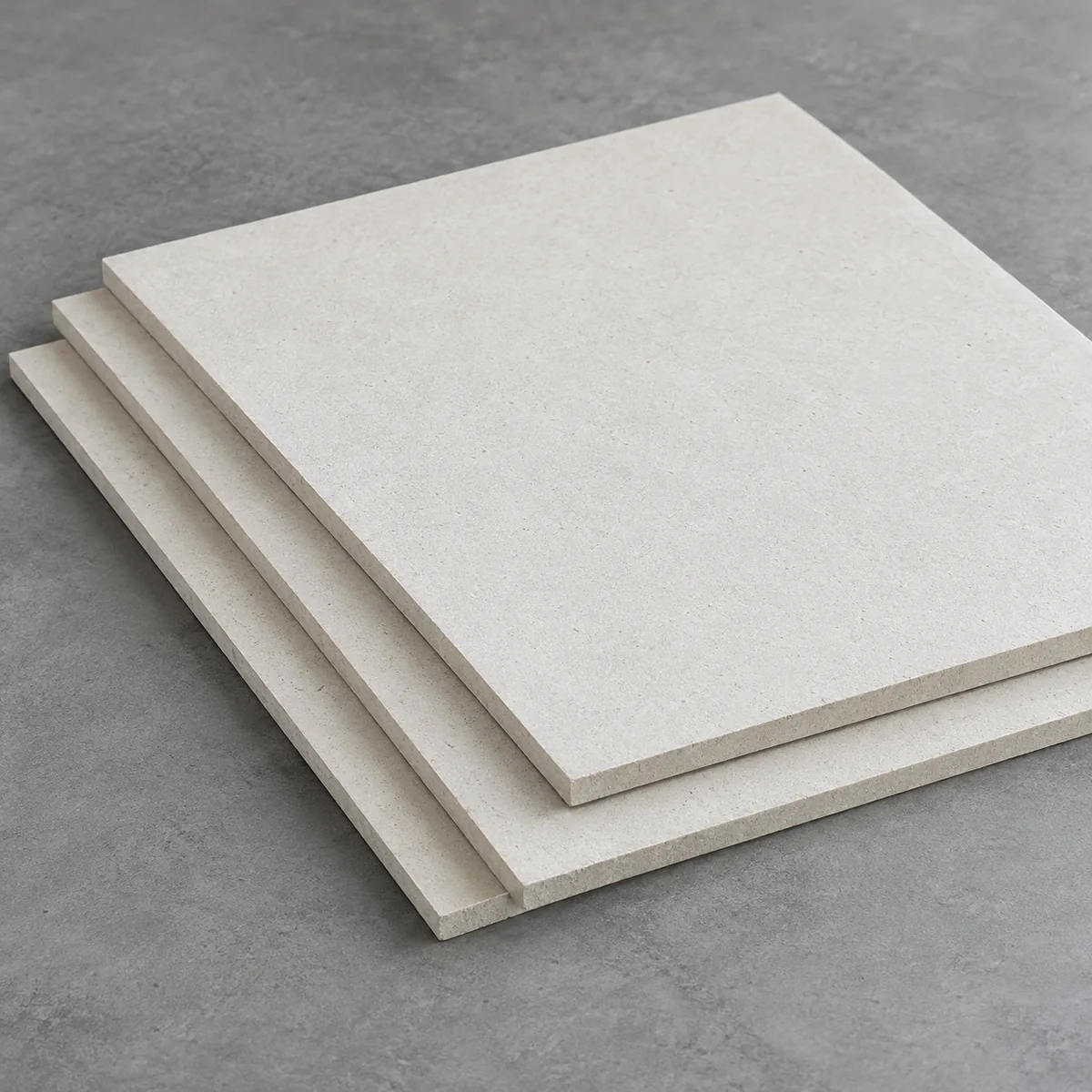
When comparing a calcium silicate board supplier, a thermal conductivity figure is useful only when the product identity, measurement conditions and intended application are clear. A low number copied into a quotation does not establish the insulation performance of a finished wall, ceiling or equipment enclosure.
This guide helps overseas importers, architects and contractors review thermal submissions before approving an order. It separates material data from assembly performance and provides seven practical checks. It does not assign a thermal value, temperature limit or certification to any Mainland product.
Start With the Board’s Role in the Construction
State whether the board will serve as an interior lining, a ceiling panel, a facing within a composite or a purpose-designed insulating component. Do not assume that products sharing a calcium silicate description are interchangeable. Mechanical duty, exposure, attachment and temperature requirements still need separate review.
Identify the proposed grade on the Standard Calcium Silicate Boards product page and compare its intended role with the wider building-board product range. Ask for grade-specific evidence instead of applying a value from another board or an unrelated insulation catalogue.
Seven Checks Before Accepting Thermal Data
1. Match the report to the supplied grade
Reconcile the manufacturer’s name, product code, manufacturing location and specimen description with the quotation. Record the tested thickness, density and any facing or coating. A result for an unfaced sample does not automatically describe a laminated panel, and a generic material name is not sufficient product identification.
2. Read the method and temperatures together
Intertek’s overview of heat-flow-meter testing describes a specimen placed between temperature-controlled plates to determine thermal transmission properties. Request the method reference and edition, mean specimen temperature, temperature difference and heat-flow direction where applicable. The laboratory should confirm that the method is suitable for the specimen.
Compare results under equivalent conditions. If one submission omits its test temperature or uses a different preparation, mark the comparison unresolved. Do not extrapolate a room-temperature result to sustained high-temperature service without relevant evidence and professional review.
3. Separate conductivity, layer resistance and U-value
Thermal conductivity, often written as lambda or k, uses units of W/(m K). A layer’s thermal resistance in SI units uses m2 K/W. For a homogeneous layer in the simple one-dimensional calculation, resistance equals thickness in metres divided by conductivity: R = d/k. Keep the units and assumptions with the calculation.
Hypothetical calculation only: for a 12 mm homogeneous layer and an assumed conductivity of 0.24 W/(m K), convert thickness to 0.012 m. The layer resistance is 0.012 / 0.24 = 0.050 m2 K/W. These are invented teaching inputs, not Mainland specifications, acceptance limits or evidence of product availability.
A whole-wall U-value, expressed in W/(m2 K), requires the appropriate assembly calculation. Do not treat the reciprocal of this board-only resistance as the U-value of a complete construction. Also identify the unit system: an unqualified US R-value is not numerically interchangeable with an SI resistance value.
4. Record conditioning, density and the value’s basis
Ask whether the specimen was dried or otherwise conditioned and how that condition was recorded. Keep measured density and thickness with the thermal result. Distinguish a laboratory measurement from a declared value or a design value: ask who established each value and which adjustments or assumptions were applied.
Our separate density and board-weight guide explains mass calculations. Density helps identify and compare samples, but it is not a substitute for a conductivity measurement. Do not infer an exact thermal value from weight alone.
5. Check the assembly, not just its flat layers
Metal framing, brackets and other repeating or local bridges can change heat flow through the construction. The Australian government’s Your Home insulation guidance distinguishes material and total assembly resistance and identifies thermal bridging as a factor reducing performance.
Give the designer the actual build-up, fixing arrangement and junction details. Ask how the calculation treats framing paths, surface resistances and air spaces. Do not simply add ideal layer values and present the result as an assessed whole-wall performance. Any local code acceptance remains a project-specific review.
6. Keep thermal and fire requirements separate
Conductivity does not establish reaction-to-fire classification, fire-resistance duration or a maximum continuous operating temperature. Request the relevant documents separately and match their scope to the proposed product or assembly. A board selected for a lining application should not be re-described as industrial insulation based only on its chemical family.
7. Connect approval to the order and change process
List the accepted report, product revision and calculation assumptions in the technical submittal. Agree which changes require review, such as a different grade, thickness, facing or manufacturing source. Use the calcium silicate sample-approval checklist to connect approved samples with the production reference; a visual sample alone cannot verify conductivity.
Thermal Information to Include in the RFQ
Use this schedule to obtain comparable submissions. Leave unsupported values open for clarification rather than inserting an industry average. The entries below are information requests, not universal purchasing limits.
On a small screen, swipe the table horizontally to read all columns.
| Review field | Information to request | Comparison check |
|---|---|---|
| Grade and build-up | Product code, manufacturer, facing and intended application | Does the evidence describe the offered construction? |
| Specimen geometry | Thickness in mm, density in kg/m3 and preparation | Are the sample and quoted board comparable? |
| Test conditions | Method, edition, temperatures and heat-flow direction where relevant | Are conditions stated and appropriate for the review? |
| Thermal result | Conductivity in W/(m K), original result and reported limitations | Is this a measured, declared or design value? |
| Assembly assessment | Layer schedule, framing, junctions and calculation assumptions | Is board resistance kept separate from whole-wall performance? |
| Approval record | Report reference, reviewer, accepted revision and change procedure | What needs clarification before purchase release? |
Frequently Asked Questions
Is a lower conductivity figure always the best choice?
Lower conductivity means greater resistance at the same thickness and comparable conditions. It does not establish fitness for every application. Also review strength, fixing, moisture exposure, finish compatibility and the evidence required for the assembly.
Does increasing board thickness improve the whole wall proportionally?
For the simplified layer calculation, resistance increases with thickness when conductivity stays the same. Whole-wall performance also involves other layers and heat-flow paths, so the complete construction does not necessarily improve in the same proportion.
Can a thermal report prove a fire rating?
No. Thermal transmission data and fire-performance evidence answer different questions. Review the applicable fire documents separately, including the precise assembly and limitations where an assembly rating is required.
What if a quotation gives conductivity without conditions?
Request the full supporting document and identify the test method, product, specimen condition and temperatures. Keep the value provisional until the missing information is resolved; do not fill gaps with another supplier’s data.
Request a Grade-Specific Technical Submission
When contacting a calcium silicate board supplier, provide the application, thickness, assembly build-up, destination and thermal evidence requested by the designer. Mainland’s Technical Documents enquiry page helps organise a product-specific request. Document availability and applicability must be confirmed for the selected grade before approval.
Discuss your calcium silicate board specification with the proposed quantity and the outstanding technical questions. Illustrative sample images are not thermal test evidence, and the hypothetical calculation above is not a product declaration.